Indonesia: Wakatobi & Star Clipper
Sri Lanka & Maldives: snorkel boat GAHAA; dive boat Conte Max; Vilamendhoo resort
Africa: Garonga, Simbavati, Arathusa camps in So. Africa
Victoria Falls
Chobe river safari
Nambia safari
Friday, December 22, 2017
I am a year late in posting this addition to the blog.
We went to Antarctica over the Christmas/New Years holiday 2106/2017. Temperatures at that time where we were were in Antarctica were warmer than temperatures throughout Oregon. Antarctica was a strange place to go to escape from the cold.
We left Ushuaia, Argentina on the Summer Solstice. It snowed in the surrounding mountains and a little bit in town that day.
Other than our return trip across the Drake Passage when we had about 30 mph winds with snow and 3 foot swells we enjoyed great weather and calm seas.
It is a rarity for passengers to go ashore twice every day when the ship is in areas where landings are possible (as opposed to being in transit). We did.
During a typical cruise of this type, we were told, all - or nearly all - of the penguins have chicks at the same stage of development. We saw chicks at all stages of development.
We expected to have a trip that was basically in black and white. There were nearly always amazing scenes that included icebergs, mountains, sun, blue sky, clouds, blue and green waters, whales, and quite a few types of birds and seals. But there was not a single tree.
We were told to expect awful smells when we were near and in the penguin rookeries - but apparently we were early enough in the season so we did not encounter that problem.
This trip to Africa is my wife's retirement trip. We will be home almost in time to celebrate the one-year anniversary of her retirement. One of the main possibilities that put this trip at the top of the priority list is that she wanted to see Meerkats in the Kalahari Desert. So our final Safari destination for this trip was Kalahari Red Dunes Lodge on the edge of the Kalahari.
The lodge is in a fenced reserve. There are no predators. So, in the words of our guide, "the animals here die of old age". The residents include Impala, Blue Wildebeests, Black Wildebeests, Red Hartebeests, Springboks, Black Springboks (not native), ,Oryxes, Elands, Ostriches, Wart Hogs, Mongooses, Ground Squirrels, and of course Meerkats, among others. 8" long millipedes were everywhere. The most noteworthy bird there is the Social Weaver. Colonies of them build huge interconnected nests. The largest we saw was probably 4 feet high, 3 feet wide and 15 feet long. When they get wet sometimes they break the trees in which they were built. We saw one that had fallen. Unlike the area near Kruger in South Africa where you could get very close to the wildlife; and unlike Etosha where the animals ignored us when we were on the road; the animals here were very shy. They often started running from us when we were 1/4 to 1/2 mile away.
Unfortunately, we only got a glimpse of one Meerkat in the wild. Fortunately, there is a Meerkat named Toffee that prefers to spend her time with people rather than other Meerkats. Typically she shows up for Breakfast, Lunch and Dinner at the lodge. When we got back from our first sundowner (game drive that ends with a beverage of your choice at a good location for watching the sun go down), Toffee was waiting for us at the feet of our guide, Usko. So my wife got her first contact with Toffee.
The following morning Toffee showed up at about 11 to get some attention from our cousin at poolside. She stayed there and hung out with any of us who were willing to scratch her tummy. When we went inside for lunch she followed us in and hung out with us before mingling with the dozen or so people in the French family that was seated around the other table. Then she came back for some more attention and a nap under our table. She stayed around until about 4 in the afternoon.
Toffee
Since this is a predator-free reserve we were free to wander. So we went looking for Meerkats in the wild on foot. We didn't find any. I should mention that Toffee seems to live near the guides' accommodation which is about 150 yards from the lodge. There is a wood walkway about 1 to 2 feet off the ground between the guides' quarters and the lodge. Toffee seemed to like to follow Usko from the guide's quarters to the lodge.
On our second evening our dinner was served in a building near the guides' quarters. When we left to go there Toffee was already at the lodge. As we walked noisily along the path Toffee kept up with us on the ground.
In spite of the fact that we did not have a quality experience with wild Meerkats my wife is very satisfied with the experience overall.
I am attaching a photo of our unit. We did not even use the sitting room. That is the module on the left. The picture window faces the large open field and the lodge which is about a 150 to 200 yard walk from our unit.
Our Unit
_____________________________
For a video showing what we saw during our Namibia safari from October 16 thru October 28 and with a little bit from the Cape of Good Hope in South Africa (including Penguins) click on the following video:
The road to this lodge is very steep. It would be impassible for 2 wheel-drive vehicles. The lodge is about a mile above sea level. It is situated at the end of a long canyon. The view is fantastic.
Shortly after we got to Grootberg we went for a short walk. When we returned there was an Oryx less that 100 yards from the parking lot.
While we were at Grootberg we went on a Rhino Tracking safari. We drove down a very scenic canyon crossing the dry creek bed many times. The road was VERY rough. I have some video that shows how rough it was. Eventually our trackers did find the Rhino and led us on foot to where we would be able to see him. While we were hiking around the Rhino circled us. We saw him three times. He was Alex. He had been dehorned in hopes that if poachers found him they would not kill him for his horns.
Alex
While we were in the valley we saw Giraffes in the distance and several small dazzles of Zebras.
The next day was a travel day. We went to Erongo Wilderness lodge for the night. They had tailless rodents called Hyrax and lots of Love Birds.
Hyrax
Love Birds
Mountain Zebra (has full stripes down to his hooves)
Of course we saw occasional Ostriches, Giraffes, Zebras, and various types of antelope along the way.
When we left Uukwaluudhi we went to the town of Opuwo and checked in at the Opuwo Country Lodge. From there we visited Epupa Falls on the border between Namibia and Angola. The river is very wide above the falls and has many islands. In fact the "falls" is a spread out collection of many small falls. From where we were staying in Opuwo it was about a 120 mile trip over a dirt road that has a washboard surface most of the way.
We also visited a Himba village while we were staying at Opuwo. The women still dressed in the traditional way. Their hair is constrained with a waxy substance from their scalps in 1/2" diameter bundles to about 3 inches from the ends where there are balls of hair (like ratted hair). They wear only jewelry above their waists. They carry babies in sarongs on their backs. An ochra paste is spread on all exposed skin. There were a significant number of Himba women in the town of Opuwo. I did not figure out how being in town fits in with village life or whether they live in town but continue to dress in the traditional way.
Except for the leader of the village all of the men were away - tending herds of cattle. They do not spend much time in the village. The village had no running water. The small houses are built from materials available in the bush. The children do go to school to learn English. One 14-year old girl we spoke with was in the second grade. Some seek employment in the modern society. To get jobs they wear "western" clothing.
After we talked to a group of about eight women we were asked whether we were interested in buying any hand crafted items. Without knowing the consequences Diane's sister and cousin expressed an interest. We were invited into one of the huts where a woman showed us how the ochra paste is made. When we left the tent there were about 50 women and girls arranged in a circle. Each had crafts to sell. This was a surprise to all of us - including our guide.
As we traveled across the West side of Etosha park we passed several plains. At times there was wind, and we even had some sprinkles. One spot in the road was actually wet and had some puddles. It wasn't much, but it was more that had been seen for months. We saw several Ostriches along the way.
The Ostrich Family - chicks at right
We stopped atone waterhole when it was windy. It was kind of surreal, ghostly even. But there was entertainment here, too. One of the Oryxes felt it necessary to assert himself. These two sparred for several minutes.
Aside from that there were quite a few Zebras, Wildebeests, Springbok, and Red Hartebeests there for a drink, too.
It was a good day in the reserve, but not a great day. Nothing like the events of yesterday.
As we traveled across the West side of Etosha park we passed several plains. At times there was wind, and we even had some sprinkles. One spot in the road was actually wet and had some puddles. It wasn't much, but it was more that had been seen for months. We saw several Ostriches along the way.
We stopped atone waterhole when it was windy. It was kind of surreal, ghostly even. But there was entertainment here, too. One of the Oryxes felt it necessary to assert himself. These two sparred for several minutes.
Aside from that there were quite a few Zebras, Wildebeests, Springbok, and Red Hartebeests there for a drink, too.
It was a good day in the reserve, but not a great day. Nothing like the events of yesterday.
Monday October 19 This was our most amazing day of the trip so far. I really didn't want to trim my report - so it is unusually long.
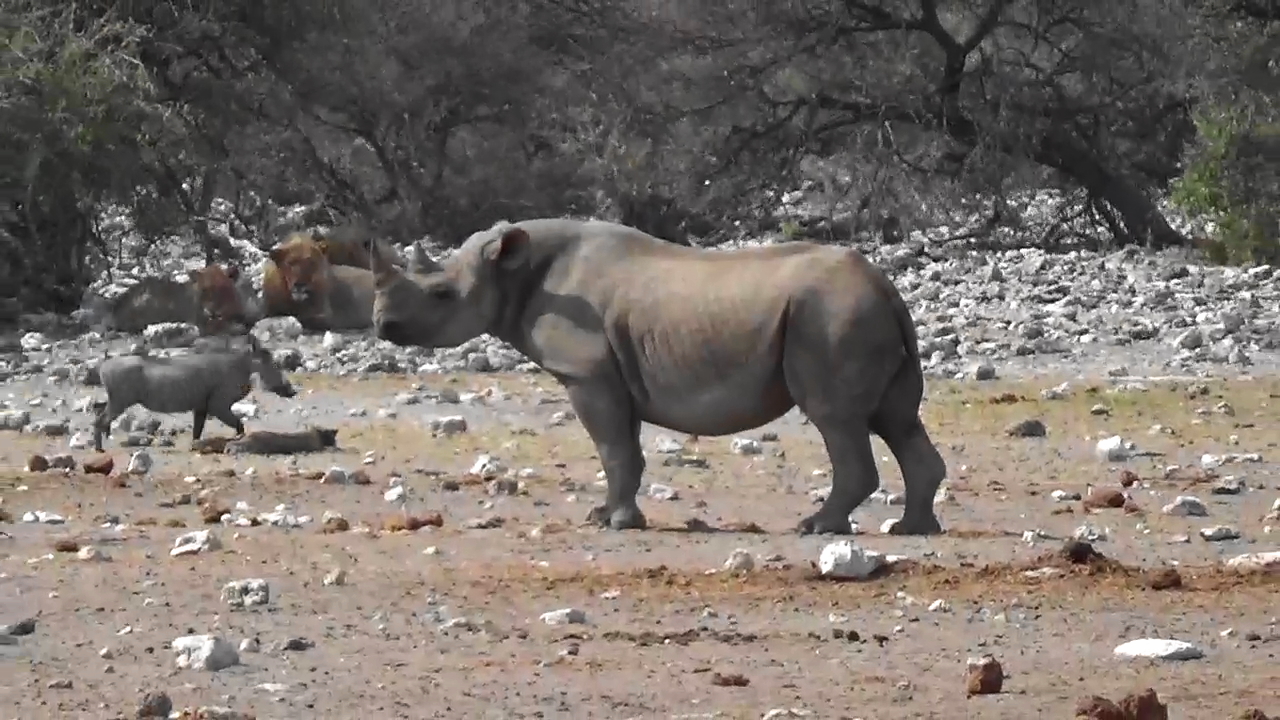
When we reached the Chudop waterhole near the East gate of Etosha Park there was a fair number of animals nearby but none were at the water's edge. A quick scan of the nearest cover (small, bushy trees) revealed three Lions across the pond from us. One of them was obviously eating, but we could not tell what kind of animal was on the menu.
There were at least a half dozen each of Black-back Jackals and Spotted Hyenas near the Lions. The Jackals appeared to be trotting within a few feet of the Lions. They and the Hyenas were waiting for their turn to clean up after the Lions left the remains unattended.
We waited a while and almost decided to leave. Then one of the Lions got up and wandered slowly toward the water hole. The others followed. They all had a drink. Their faces were covered in blood up to their eyebrows except for where their respective tongues could clean their faces.
When the last Lion left the Hyenas and Jackals moved in as though they were being sucked in by a vacuum. One of the Hyenas got a piece of the kill and ran off with it. Another Hyena was in hot pursuit - but finally gave up. When the last Lion to leave turned back toward the carcass for a moment the Hyenas and Jackals became more wary but did not disperse.
Last Lion leaves the kill; scavengers move in
Lion turns back toward the kill, scavengers become wary
There must not have been much left; the site of the feast was soon void of even the scavengers. The kill must have been a relatively small one. These Lions did not appear to be full. Their bellies did not appear to be bloated and they were not breathing with shallow breaths. After the Lions had had their drinks they laid in the bowl of the waterhole on the side away from us.
A pair of warthogs walked (what we considered to be) dangerously close to one of the Lions; then retreated with most of his dignity. After doing that a few times he and another Warthog went to a place that was about a quarter of the way around the waterhole from the nearest Lion and had a drink. While they were warily enjoying their drink one of the Lions positioned herself behind them; then ran a few steps toward them. One Wart-hog went left and the other right. The Lioness did not get close to either one.
After a while the Lions found a shady spot under a bush about 50 yards from the site of the feast and got comfortable.
About that time a Black Rhino started coming in from the left. He weaved around some bushes between where he became visible and wandered indirectly toward the Lions. When he was about 25 yards from the Lions he started sauntering toward the pool. One of the Wart-Hogs got his attention and he chased it across to the far side of the pond and back again. Then he chased an Eland about 50 yards. He trotted over in front of the Lions and posed for a shot with them and a Wart Hog for us before he wandered off into the bushes on the right side of the pond. He never did go to the water for a drink.
In the meantime more of the grazers and browsers were showing up for their morning drink. Zebras, Impalas, Springboks, Giraffes, Kudu, Oryx were assembling to our right. Some Elands also came in. This was the first time we had seen them. They are the largest of the Antelope and weigh up to about 2000 lbs.
Eventually one of the Giraffes went to the water's edge and nervously had a drink. Then he was joined by other Giraffes. Then all of the assembled grazers and browsers went in for a drink. What a sight.
Giraffe, Zebras, Wildebeest, Eland
Zebras, Kudus, and an Impala
Kudus and Impalas
At another water hole we saw a family of Lions that included two young cubs. They were enjoying the shade of a solar collector that was used to pump water to the waterhole.
We also saw Ostriches that were close enough that we could see them clearly. --and of course Elephants. One small group had a youngster that just wanted to play. He was constantly messing with his older sibling. Unfortunately, his antics could not be recorded in a photo, but the video is good. We also saw Red Hartebeests for the first time, including the ones locking horns.
The Big Elephant shown in the photo is on ground that is about 1 to 2 feet above the car, but he IS big.
He was following another big fella on a path where they were preceded by a procession of over 100 Springboks and a Blue Wildebeest. They were going down to a large plain where there must have already been over 500 browsers and grazers (my estimate is probably very low) of all descriptions. It was an amazing sight.
During dinner at Andersson's Camp three Lions and a Rhino visited the waterhole at our bush camp. We could hear Lions doing low roars to communicate with each other as we were going to bed. They sounded very close but I could not see them with my small flashlight. The electric fence to keep them out of our cabin was on the railing of our deck.
Andersson's Camp was an interesting place. The waterhole was within 50 yards of the open air restaurant and it had a "Hide". A Hide is a place where you can view the animals safely from 5 to 50 feet away - at water hole level. Think "bunker." The entrance is a tunnel so animals cannot see you enter the hide. Viewing is through an un-windowed slot. The private housing units consist of a structure made from baskets of rock - similar to what we use here along highways to prevent slides. The shower had no inside wall or curtain. While taking a shower we stood in a feeding trough-type tub. The floor of the tub was about 14" below floor level. Kinda wierd; but kind of cool in a way.